

Henco Nel — a passion for patient-centred care
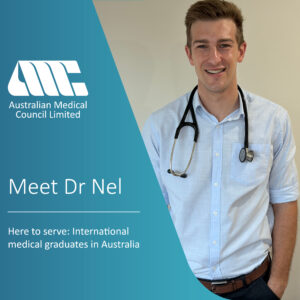
It’s 7am on a Wednesday morning and Henco is on the train, heading to the Fiona Stanley hospital in Perth where he works as an Infectious Diseases Advanced Trainee. By mid-morning he will have reviewed in-patients with advanced HIV and opportunistic infections, tuberculosis, and returned travellers presenting with fevers. Later that day he’ll see inpatient consults with complicated infections including infective endocarditis and infections in organ transplant recipients before moving to clinic to care for patients with diabetes-related foot disease and other bone and joint infections.
It’s demanding, intellectually rigorous work — but for Henco, it is also extremely valuable and rewarding. “I’ve been fortunate to work closely with esteemed clinicians and researchers,” he says, “and to lead multiple investigator-initiated trials while also contributing to large, practice-changing international studies.”
Working across several infectious diseases departments in Western Australia has also given him something less tangible, but equally important: a strong sense of belonging to a broader professional community united by shared values and a common purpose.
Henco moved to Perth from South Africa in 2020 where he completed his basic physician training. He went on to undertake dual subspecialty training in infectious diseases and general medicine — a path shaped by his early experiences as a junior doctor in regional hospitals in South Africa. His interest in infectious diseases began there, caring for vulnerable patients with complex health challenges.
“Managing patients from incredibly poor backgrounds with advanced HIV, multi-drug-resistant tuberculosis, postpartum sepsis, and children with severe malnutrition and complicated infections — I saw first-hand how infectious diseases intersect with injustice and health disparities,” Henco recalls. “Infectious diseases physicians have a unique opportunity to advocate for some of the most underrepresented patient populations.”
Henco grew up in Bloemfontein, a small city in central South Africa, where he completed his undergraduate medical degree. From early on, he was driven by a desire to make a meaningful difference in people’s lives. “Throughout my career, I’ve been fortunate to work with physicians who demonstrate a relentless commitment to caring for and advocating for their patients,” he says. “They’ve continuously reminded me why I became a doctor in the first place. Medicine brings together science, problem-solving, compassion and lifelong learning — and that still inspires me.”
Working overseas had always been part of Henco’s plan. He wanted exposure to diverse patient populations and opportunities to grow his clinical and research skills. “Australia appealed to me because of its high clinical standards, strong training pathways and focus on evidence-based, patient-centred care,” he says. “My wife and I first visited Perth in 2015 and immediately felt connected to the culture and lifestyle.”
While completing his medical internship in South Africa, Henco embarked on the standard pathway to registration and working in Australia.
“The process was thorough and challenging but also exciting,” he said. “I completed AMC examinations while working 60-hour weeks in understaffed regional hospitals in South Africa. The biggest challenges were finding time and saving enough money to cover the costs.”
At the time, there were no Multiple-Choice Question Examination centres in South Africa, so Henco flew to Perth to sit the exam. The following year, after passing the MCQ exam, he travelled again — this time to Melbourne — to sit the clinical examination.
Henco approached exam preparation with a structured long-term study plan that emphasised Australian clinical guidelines and clinical reasoning rather than rote memorisation. He relied heavily on AMC handbooks, supplementing them with additional reading on commonly examined conditions, medications and management approaches. Online question banks and discussion groups with other international medical graduates also proved invaluable.
Despite the intensity, Henco believes the preparation strengthened him as a clinician — not only for Australia, but in South Africa as well.
“The exams are generalist by design. You revise across multiple specialties, which mirrored the reality of my work in South Africa, where I was managing a broad range of conditions,” he explains. “I also appreciated the holistic nature of the exams. They focus strongly on patient-centred, individualised care. That aligned well with how I practise.”
Throughout the process, he credits the steady support of his wife. “Emotional support — whether from partners, friends or family — is essential. I encourage future candidates to lean on the people closest to them.”
Today, Henco thrives on the intellectual challenges of infectious diseases and the opportunity to integrate patient care with research. He sees Western Australia as an exceptional place to train, offering diverse clinical settings and patient populations.
With particular interests in the gut microbiome, transplant infectious diseases and musculoskeletal infections, Henco hopes to improve patient-centred outcomes through research and holistic care. “I’ve been fortunate to interact with colleagues and patients from many different backgrounds,” he says. “It’s broadened my understanding of what it means to be a good doctor — and ultimately, a good human being.”
Those experiences have reinforced for him the importance of tailoring care to each individual patient. “We must remain focused on our patients’ values and goals. Every patient encounter is an opportunity to improve someone’s quality of life — however they define that.”
Now settled in Perth with his wife and two young daughters, Henco plans to complete advanced training in infectious diseases and pursue a career as a clinician-researcher.
While the journey to Australia was demanding and at times uncertain, he has no regrets. “Even though our relocation wasn’t straightforward, we’ve never looked back. We would definitely do it all over again,” he said.
Henco believes international medical graduates enrich Australia’s healthcare system through their diverse experiences, resilience and adaptability. He hopes others considering the journey feel empowered to take the leap.
“It’s challenging,” he says, “but it’s absolutely worth it.”

