

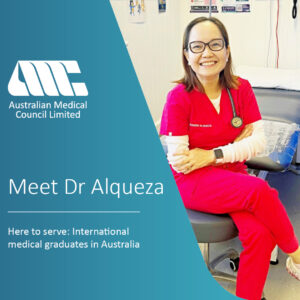
For Noreen Alqueza, the appeal of working as a generalist doctor in rural communities lies in the unique combination of community connection, clinical diversity and the opportunity to make a difference.
“In rural settings, you are closely connected to the community, which makes the work more meaningful despite its challenges,” Noreen said. “No two days are the same. I might move from a complex paediatric consultation in the morning to procedural work in the afternoon.”
For the past decade, Noreen has worked across the Aboriginal Medical Services (AMS) Sector and private general practice in rural and remote communities across Australia. She is currently a Rural Generalist trainee with the Royal Australian College of General Practitioners.
Before moving to Australia, Noreen was working in both Singapore and the Philippines where she completed her medical and paediatric training. It was her work in rural general practice in the Philippines that exposed her to a broad range of clinical presentations — from delivering babies to managing chronic disease — experiences that would later prove invaluable in rural and remote Australia.
Finding a home in Australia
Noreen moved to Australia seeking both new professional opportunities and a better long-term environment for her family. While the climate and lifestyle were strong attractions, Noreen was also drawn to the Australian healthcare environment which aligned with the kind of doctor she wanted to be. “What stood out to me was a system that supports broad, versatile practice where I could continue developing clinically while working across both hospital and community settings,” she said.
“At the time, I didn’t know what a Rural Generalist was. It wasn’t until I moved into general practice here, that I realised Australia had developed a unique Rural Generalist framework that perfectly integrated my hospital background with community .”
“Australia was the place where I could truly be both a hospital and community clinician.”
Noreen’s pathway to registration in Australia began in 2013 while she was still in the Philippines preparing for the AMC Multiple Choice Question (MCQ) examination.
After passing the MCQ examination, she immediately began applying for roles in Australia.
“That evening after receiving my results, I sent off a handful of applications,” she said. “The next day I was invited to an interview and started work in January the following year at Mater Health Services in Brisbane.”
“I’m very grateful to Mater Health Services for supporting my initial move, and to Hervey Bay Hospital where I completed the rotations required for General Registration,” she said.
Although Noreen initially considered specialising in paediatrics, a year working in general practice shifted her perspective. Rather than pursuing a hospital-based paediatric career, Noreen found herself drawn to rural general practice — a pathway that combines a broad scope of practice with continuity of care and community connection.
Noreen had originally planned to complete the AMC Clinical Examination as part of the standard pathway but then discovered the Workplace-Based Assessment (WBA) program.
“There were only five hospitals offering the WBA program in Australia at that time,” she said. “I feel very lucky to have been given a place in the program at Hervey Bay Hospital. It also allowed me to complete my rotations while doing the WBA.”
The WBA program assesses doctors in real clinical environments over six to twelve months, evaluating a range of clinical skills and professional behaviours.
“It allowed me to demonstrate my clinical ability in a real-world regional setting over time, which aligned closely with my prior experience,” she said.
Because she was already working within the Australian healthcare system, Noreen said she could focus on adapting to the clinical environment rather than searching for employment.
“For the WBA, the preparation was simply the work itself,” she said.
“Being immersed in a clinical environment at Hervey Bay and Maryborough Hospitals meant every patient interaction, ward round and multidisciplinary discussion contributed to assessment, making it a practical and continuous way to demonstrate competence.”
Like many international medical graduates, Noreen found adapting to Australia’s health system one of the biggest challenges.
“The primary challenge was adapting to the specific regulatory and administrative frameworks of the Australian health system while simultaneously navigating a new medico-legal and cultural landscape,” she said.
What helped most, she says, was immersion.
Over the years, Noreen has worked across metropolitan, regional and remote settings, including Queensland Children’s Hospital, Mater Health, Monash Health, private practices on the Sunshine Coast, Aboriginal Community Controlled Health Services in Dalby and Gympie, and remote communities such as Bamaga.
The importance of trust
Some of Noreen’s most significant professional experiences in Australia came through her work in the Aboriginal Medical Services sector.
Early in her Australian training, she spent almost two years working in rural and regional communities where she developed a deeper understanding of integrated team care, cultural safety and the importance of trust in healthcare.
“Clinical care is important,” she said. “But what is equally important is building rapport with patients and the community.”
“Working in the Aboriginal Medical Service sector reminded me of that instinct — clinical excellence is ineffective without trust. It reinforced that the clinical part is only the beginning; treatment happens when a patient feels culturally safe.”
Noreen says the experience reminded her of the values that first shaped her approach to medicine in the Philippines.
“In the Philippines, the connection between culture, family and medicine is innate; you treat a patient within the context of their beliefs, values and community connection,” she said.
International medical graduates now make up more than half of Australia’s general practice workforce and play a critical role in rural and remote communities. Noreen believes international medical graduates bring valuable skills, experience and perspectives that are sometimes underestimated.
“International Medical Graduates are not simply filling workforce gaps,” she said.
“We are skilled professionals who bring a global perspective to the Australian healthcare system.”
“Many of us have already worked in high-responsibility roles before arriving, and a significant number choose to work and remain in rural areas long-term, contributing to both service delivery and continuity.”
For Noreen, the journey from the Philippines to rural Australia has been one of discovery — adapting to a new country and healthcare system while finding a professional pathway where she can truly make a difference.
“It’s been rewarding to find that the experiences I’ve gained throughout my career can be applied meaningfully in rural communities,” she said.
“Having clinicians who can bridge the gap between private general practice and the local emergency clinic is vital for the sustainability of smaller communities. I can provide family-centred continuity of care—from supporting newborns to managing chronic disease—right where it is needed most.”
Noreen hopes to transition into Advanced Skills Training with Queensland Health, building on her background in paediatrics and neonatology to provide more complete, family-centred care in rural settings.
Alongside her clinical work, Noreen is also a member of the Australian Medical Council’s Assessment Committee and is completing a Master of Public Health focused on international medical graduates working in rural and remote Australia.
Her research explores what helps international medical graduates integrate, remain and thrive in rural communities with the goal of identifying practical solutions for long-term workforce sustainability.

