English language competence project
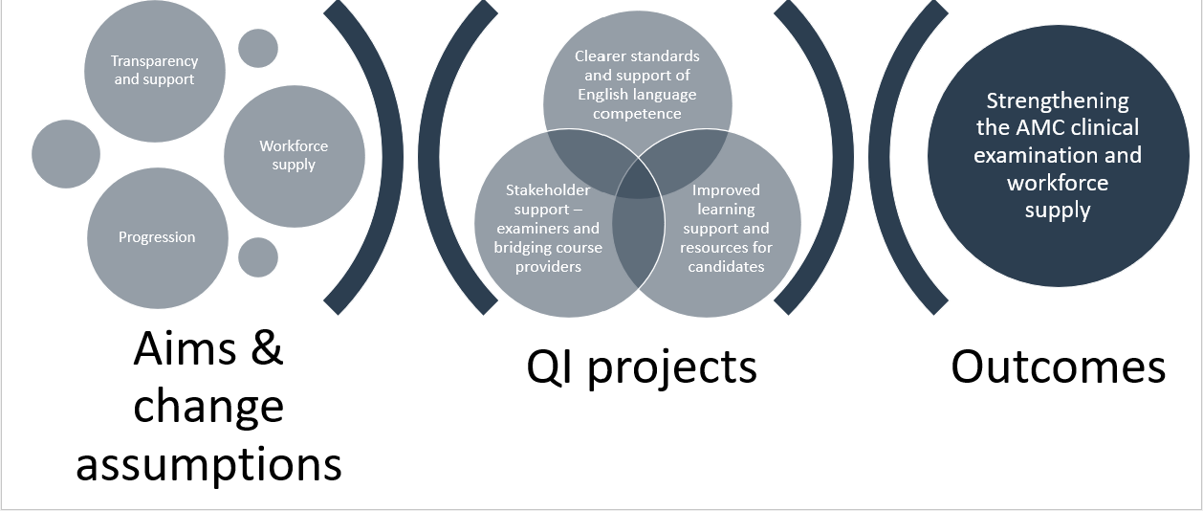
The aim of this project is to better understand the current state of English language requirements of the AMC clinical examination aligned with AHPRA-approved English language tests and international benchmarks.
The project seeks to address the longstanding concerns of AMC examiners about the language-level of AMC clinical examination candidates and to gain further information on the English language competence of candidates as a contributing factor to the low AMC pass rate.
The project will review a sample of candidates’ stations, assessment guidelines and tasks. It will also explore factors raised in the examiner decision-making project including cognitive load for candidates and the adequacy of reading time. Future state recommendations will include clearer guidelines on English language levels of tasks and guidelines, and advice on self-assessment opportunities and language support.
Progress
A Request for Information has been distributed to assessment and research centres who are potential research partners for this project. E Professor Amanda Barnard and Professor Jo Thomas will be the lead examiners overseeing this project with Dr Nidhi Garg.
Video development and resource hub
The aim of this project is to develop videos to provide candidates with tangible examples of a competent candidate performance of specific tasks aligned with the AMC clinical examination Predominant Assessment Areas (PAAs).
A key feature of these resources is that they will be embedded within an educational framework to support learning, which includes opportunities for reflection, understanding examiner insights into decision making, and exploration of an AI-assisted tutor to support independent learning skills.
Mid-term and longer-term aims of this project are to create videos to support interaction in the clinical examination examiner training and to produce resources on examiner bias.
Progress
A team of examiners has been established to oversee the project including Professor Amanda Barnard, Professor Liz Farmer, Professor Lambert Schuwirth and Dr Andrew Linn. Two cases have been approved and recruitment of examiners, SPs and candidates to play roles in the videos is nearing finalisation. Scripts are currently being developed along with a draft educational framework for review.
Podcasts
The aim of this project is to develop an initial 6 podcast episode series to support international medical graduate learning in areas that they find challenging in assessments and work readiness, including professionalism, the Australian health system, patient safety, complaints and breaches, living and working in rural and remote Australia and cultural safety.
Learn more about the Global Minds, Healing Hands podcast series that’s in development.
Bridging course support
In 2025, the AMC held two workshops for providers of Bridging Courses sharing information about the structure and elements of the AMC clinical exam to ensure AMC candidates receive effective and appropriate support on their journey. One workshop was held online, the second workshop was held at the AMC Test Centre, allowing providers to gain a first-hand understanding of the exam.
With the support of Simulated Patients we produced videos exploring key areas of importance in the AMC’s clinical assessment model to maximise the benefit of these workshops to participants.
In late 2026, a further workshop is planned with a focus on specific elements that candidates find challenging within each of the predominant assessment areas of the clinical exam.
Examiner training and support
This project looks at improving the interaction, learning design and support of examiner training.
The focus in early 2026 was on the review of the examiner training design to create a pre-workshop examiner video that enables examiners to prepare for their role prior to attending the training, and to facilitate interaction in the face-to-face training.
Future review of the examiner training will form part of the video development project (see above).
Improving pathways for refugees in Australia
The AMC is the industry partner on this approved ARC research grant project led by researchers at Monash, Deakin and University of Melbourne (Professors Gabrielle Wolf, Karen Dunwoodie and Neville Yeomans.)
The project aims to provide specific support for a cohort of 15 refugee doctors to support them in their progression through assessment pathways including English language support, MCQ preparation through HEAL, work readiness support through Monash health and mentoring support. The project will explore a longitudinal evaluation of progression and recommend future scaling up of the project subject to its success.
The MBA and AHPRA are other industry sponsors for the project.
This project is significant and innovative in four main ways:
- It will address a significant gap in the knowledge of key barriers faced by refugee doctors in seeking medical registration and employment, and the capacity for stakeholders to work together to support them.
- The project will make a novel theoretical contribution by adopting a socio-ecological model lens (Linjean et al., 2024) to explore the complex web of factors at the individual, cultural, organisational and systemic level faced by refugee doctors in seeking medical registration and employment in Australia.
- The project will be the first to develop, trial (with partner organisations) and evaluate a multifaceted program of support for refugee doctors to progress towards obtaining medical registration and employment in Australia.
- The project will be novel in drawing on interviews with refugee doctors and stakeholders to develop recommendations for refining and scaling up the program so it can be implemented across Australia and is sustainable. It will explore the potential adaptation of the program’s components to ensure future financial support and stakeholder engagement.
The work will involve interviews with 50 refugee doctors and key stakeholders to identify key barriers to medical registration and employment, and how existing supports for IMGs can be tailored and new supports created to meet refuge doctors’ specific needs.
The program will be trialled in the State of Victoria across 4 years through a unique collaboration between the research team, the AMC, and education and healthcare providers.
The team is currently establishing the research framework and will begin work on the project in 2027.