The Australian Medical Council is an organisation whose work impacts across the lands of Australia and New Zealand.

The Australian Medical Council acknowledges the Aboriginal and/or Torres Strait Islander Peoples as the original Australians and the Māori People as the tangata whenua (Indigenous) Peoples of Aotearoa (New Zealand). We recognise them as the traditional custodians of knowledge for these lands.

We pay our respects to them and to their Elders, both past, present and emerging, and we recognise their enduring connection to the lands we live and work on, and honour their ongoing connection to those lands, its waters and sky.

Aboriginal and/or Torres Strait Islander people should be aware that this website may contain images, voices and names of people who have passed away.

Learn more
Back

AMC Governance and Constitution Review

The AMC is currently undertaking a review of its Constitution and governance model.  This is focused on ensuring our structures and ways of working are fit-for-purpose, reflect contemporary practice and expectations, and position the AMC to navigate complexity into the future.

The proposed new model was developed through 18 months of deep work and collaboration by the AMC:

  • Members
  • Directors
  • Aboriginal and/or Torres Strait Islander and Māori Committee
  • Executive Management Team.

The process has also included engagement with key external stakeholders, including the Medical Board of Australia and Ahpra.

The proposed model was informally confirmed at the July 2026 General Meeting. The updated Constitution will be put to a vote of current members in late October 2026, with the new model expected to commence after that.

This is a significant step forward for the AMC as we continue to focus on driving better health outcomes across Australia and Aotearoa New Zealand.

Proposed AMC governance model


AMC Constitutional and Governance Review with AMC President Geoff McColl

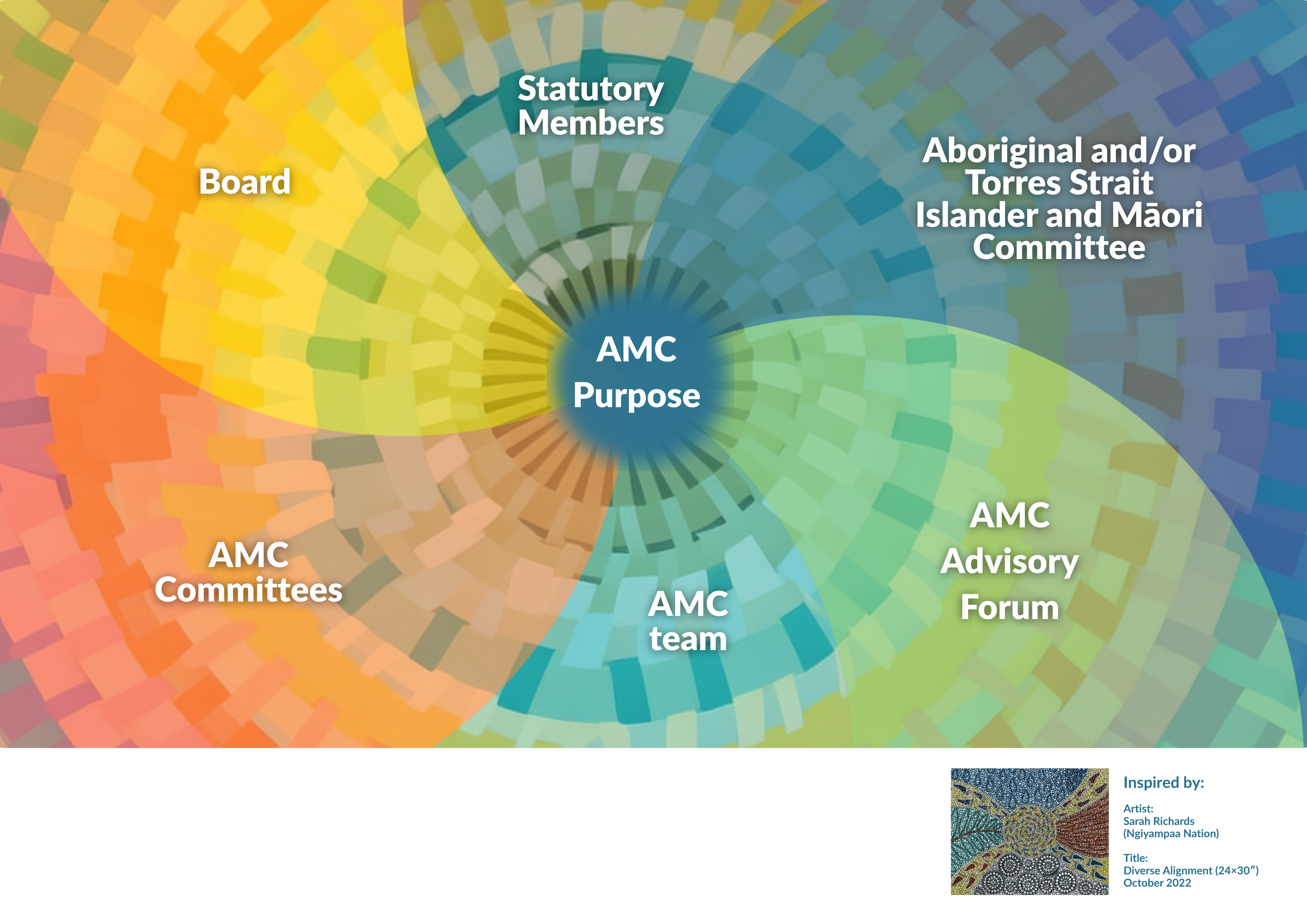
Our relational governance model

A new piece of artwork is currently being explored to translate the current visual into an enduring representation of the AMC’s governance.

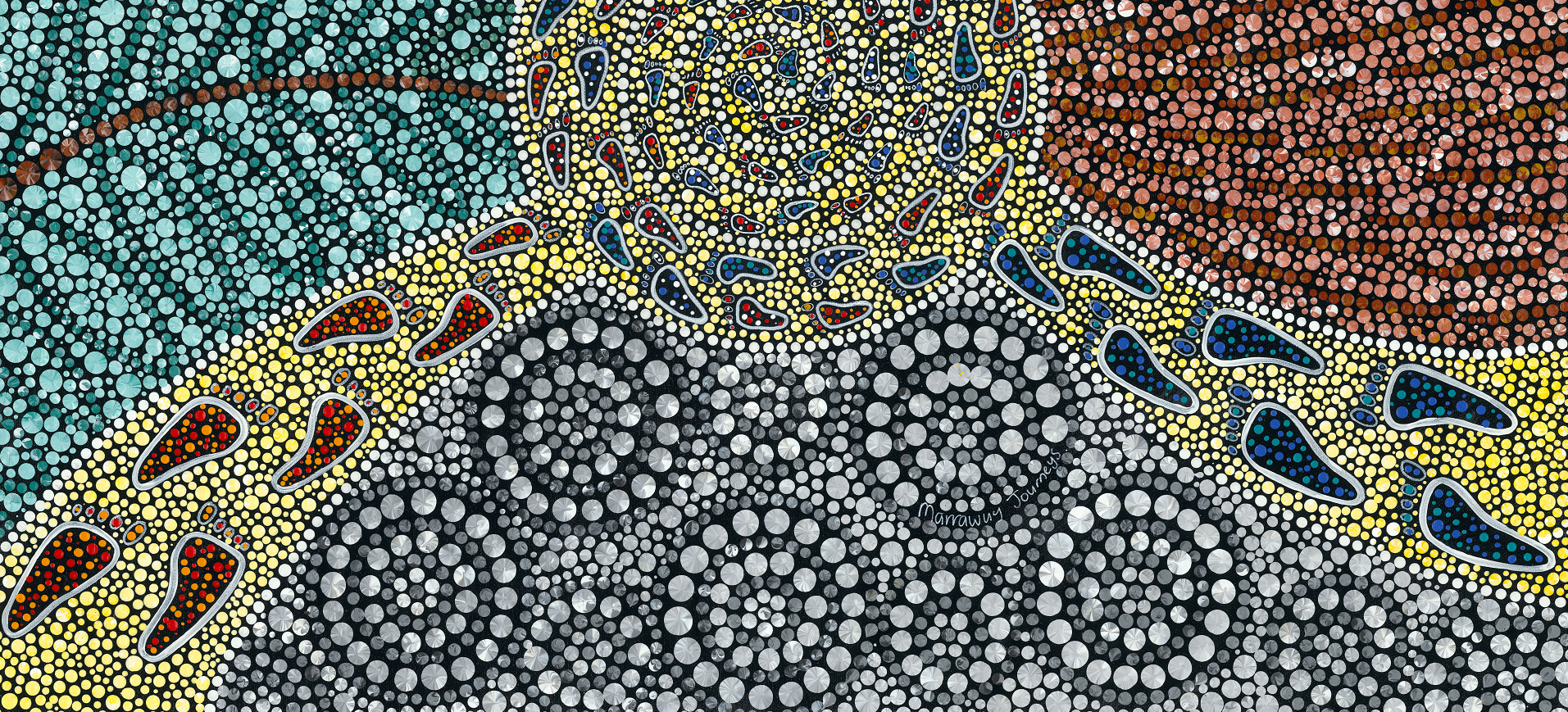
This visual was inspired by the artwork ‘Diverse Alignment’ by artist Sarah Richards (Ngiyampaa Nation), 2022. It represents both the governance of the AMC, and the way we co-created our new model together.

Each part of the governance model is represented by a different coloured strand. These voices connect and intertwine; sometimes alongside one another, sometimes shaping each other, and all weaving together. This reflects how we work across relationships, roles and systems.

The threads that make up each strand also reflect the many individuals who contribute to the AMC. It shows that our decision-making is shaped by many voices, experiences and perspectives, each contributing meaningfully to the whole.

We use our collective strengths, knowledge and shared commitment to co-create outcomes that deliver on the AMC’s purpose, and for the communities we serve.

Thank you to everyone who has contributed to the creation and ongoing refinement of this visual and articulating what it represents for us all, including the AMC Aboriginal and/or Torres Strait Islander and Māori Committee, AMC Members, Directors and the Executive Team.

Frequently asked questions


Why did the AMC decide to review its Constitution and governance model?

Unlike many governance reviews or Constitutional changes, this process was not a response to a significant problem or crisis. Instead, we are proactively introducing changes to ensure our governance is fit-for-purpose and well-placed to navigate increasing complexity over the coming years.

We are also responding to feedback from our AMC Members about their experience, including the need for greater clarity about roles, relationships and ways of working across the AMC.

Governance is strongest when it evolves ahead of pressure, rather than only in response to it. This review ensures the AMC’s capacity to deliver on its purpose keeps pace with the sector’s needs today, while also anticipating the challenges of tomorrow.


What did the review process involve, and who has contributed to the development of the new model?

The review began in late 2024, when the Board established a Review Advisory Group to identify potential refinements to the Constitution. This evolved into a broader review of the AMC’s governance model, particularly following early engagement with AMC Members.

Over the past 18 months, current AMC Members, Directors, the AMC’s Aboriginal and/or Torres Strait Islander and Māori Committee, Executive Team and governance experts have worked together to develop and test the new model. This has included iterative discussions at General Meetings, individual Member engagement, dedicated work with the Aboriginal and/or Torres Strait Islander and Māori Committee, and detailed consideration by the Board and Review Advisory Group.

The process has also included engagement with key external stakeholders, including the Medical Board of Australia and Ahpra.


What is the current status of the Review process?

AMC Members informally confirmed the proposed governance model at the July 2026 General Meeting. The model is now being translated into the amended Constitution and supporting governance documents, which Members will review before the constitutional changes are put to a formal vote at the Special General Meeting on 26 October 2026.


What benefits and outcomes is the new model expected to deliver?

The new model is intended to deliver:

  • more clearly defined roles, relationships and meaningful opportunities to contribute value in different ways to the AMC
  • greater connectedness across the AMC, supporting more integrated and effective action and decision-making
  • diverse voices and perspectives shaping good thinking and decision-making across the AMC
  • stronger shared decision-making and co-design with Aboriginal and/or Torres Strait Islander and Māori Peoples
  • better use of the collective skills, knowledge and commitment available across the AMC, and
  • greater capacity to anticipate the future and respond to emerging sector needs.

Over time, these changes will help the AMC:

  • remain relevant, impactful and sustainable
  • influence and advocate across the health and education sectors
  • play a leadership role in addressing racism and health inequity
  • strengthen the contribution our work makes to better health outcomes across Australia and Aotearoa New Zealand.


Will the new model change accreditation and assessment processes or standards?

No. The Governance and Constitution Review does not itself change the AMC’s accreditation or assessment standards, processes or deliverables. These functions will continue throughout the transition and under the new governance model. Any future changes to accreditation or assessment standards or processes would continue to occur through the AMC’s usual governance, technical and consultation processes.


Will the new model change the AMC’s work with health and education sector organisations?

The Review is focused on the AMC’s internal governance, so there will be no immediate change to our strategic and day-to-day relationships with medical schools, specialist medical colleges, health services, governments, regulators or other organisations we work with.

There will, however, be a change in how some stakeholders contribute to AMC governance. Organisations that currently nominate AMC Members will no longer do this once the new model takes effect. Instead, there will be broader opportunities to contribute through the new Advisory Forum, AMC Committees, ongoing stakeholder engagement and open expression of interest processes for governance roles, including the Board.

Over time, stronger strategic governance and broader sector and community perspectives informing the AMC’s thinking should strengthen our ability to work effectively with our partners and contribute across the sector. We hope this will foster even greater confidence in the quality of the AMC’s decision-making.


How will the new model benefit consumers and the community?

The new model will strengthen the AMC’s ability to help drive better health outcomes over time, as well as influence and advocate across the sector, and play a leadership role in addressing racism and health inequity. This will all translate into meaningful benefits for consumers and the community over the longer-term.

There will also be more opportunity for diverse voices to shape the AMC’s thinking, and ensure our approach is responsive to current and future community needs. Consumer and community perspectives will be more deliberately brought into the AMC’s strategic thinking, including through the Board Skills Matrix and the new Advisory Forum. The Forum will bring together people with different professional, community and lived experiences to help explore emerging issues, test assumptions and highlight potential impacts or perspectives that may otherwise be missed.

Please note: These governance changes do not replace the AMC’s existing engagement with consumers, communities and other stakeholders, particularly in relation to specific projects or work.


How will the voices of different groups be reflected in the model?

Diversity of knowledge, skills and experience underpins the AMC’s new governance model, including the design of the Board, Nominations Committee and Advisory Forum. The model deliberately moves away from relying primarily on people occupying governance positions as representatives of particular organisations or interests. Instead, the aim is to build collectively diverse groups that bring the skills, experience, knowledge, lived experience and perspectives needed for good decision-making.

Some specific Board composition safeguards will remain – including requirements for medical practitioners and Aboriginal and/or Torres Strait Islander and Māori Directors on the Board. Broader diversity will be actively considered through selection processes, drawing on the new Board Skills Matrix, Nominations Committee Terms of Reference and the detailed design of the Advisory Forum.

While it is impossible for any small group of people to reflect the full and rich diversity of people across Australia and Aotearoa New Zealand, the AMC’s approach is intended to ensure many different voices are embedded in the way we operate, think and make decisions.

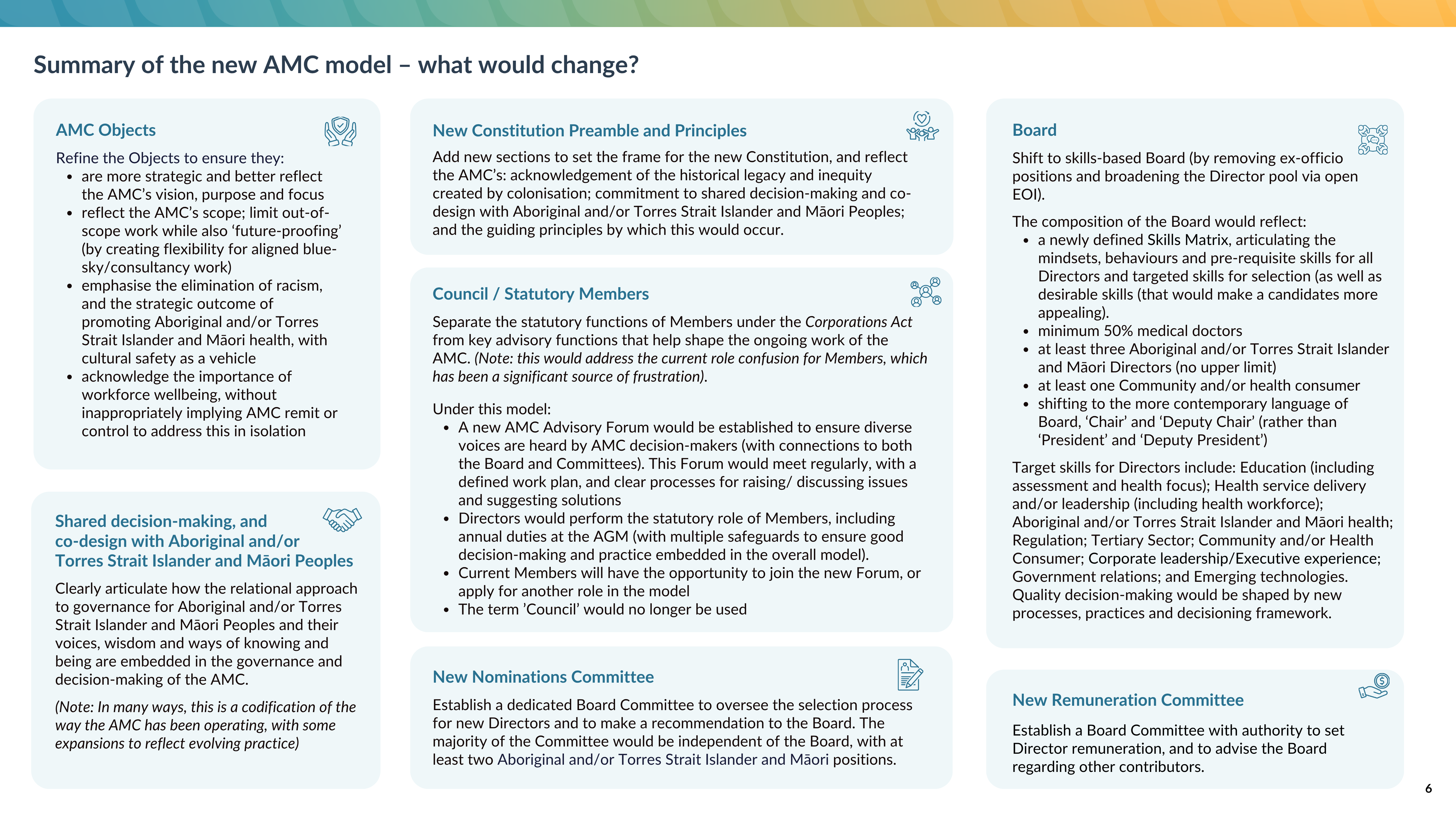
An overview of the proposed changes is provided below, with further details provided under the later sections. Adoption of the model is subject to the approval of the amended Constitution.  

Summary of the new AMC model

(Click to view the image)


AMC Constitution – Preamble and principles 

New sections have been added to set the frame for the new Constitution, and reflect the AMC’s: 

  • acknowledgement of the historical legacy and inequity created by colonisation; 
  • commitment to shared decision-making and co-design with Aboriginal and/or Torres Strait Islander and Māori Peoples; and 
  • the guiding principles by which this would occur, including relationality and cultural safety. 

While the Preamble and Principles are not an operative (enforceable) provision of the Constitution, they provide valuable context about the intent and focus of the AMC.  


AMC Objects

We have refined the Objects to ensure they:

  • are more strategic and better reflect the AMC’s vision, purpose and focus
  • reflect the AMC’s scope while providing sufficient flexibility to contribute to aligned work across the sector (where the AMC’s expertise can add value)
  • emphasise the elimination of racism, and the strategic outcome of promoting Aboriginal and/or Torres Strait Islander and Māori health, with cultural safety as a vehicle
  • acknowledge the importance of workforce wellbeing, without inappropriately implying AMC remit or control to address this in isolation.

(See below for the new draft text.) 


Shared decision-making and co-design with Aboriginal and/or Torres Strait Islander and Māori Peoples

Key governance materials (including the Constitution and new Governance Charter) will more clearly articulate the relational approach for Aboriginal and/or Torres Strait Islander and Māori Peoples, and embed their voices, wisdom and ways of knowing, in the governance and decision-making of the AMC. In many ways, this is a codification of the way the AMC has been operating, with some expansions to reflect evolving practice. Together, they will create greater clarity and consistency across the organisation. See more below. 


AMC Board

The model enables a shift to a skills-based Board by removing the five ex-officio Chair positions and introducing an open EOI process for all Director roles. (This will significantly broaden the pool of potential AMC Directors.)

The composition of the Board would reflect:

  • a newly defined Skills Matrix, which articulates: (1) the mindsets, behaviours and pre-requisite skills all Directors must bring; and (2) targeted skills to support considered and robust decision–making in the AMC context (see below)
  • minimum 50% medical doctors
  • at least three Aboriginal and/or Torres Strait Islander and Māori Directors (no upper limit)
  • at least one Community and/or health consumer Director.

Other important changes include:

  • a stronger emphasis on the critical importance of the Board being anchored in the AMC values
  • establishing a new Nominations Committee to oversee Director selection (using the new Board Skills Matrix)
  • establishing of a new Remuneration Committee to set Director fees and provide guidance to the Board about remuneration for other AMC contributors   
  • shifting to the more contemporary language of Board, ‘Chair’ and ‘Deputy Chair’ (rather than ‘President’ and ‘Deputy President’) 
  • new processes, practices and framework to support quality decision-making. 


Statutory Member model

The new model deliberately separates two key functions: the statutory functions of Members required under company law, and broader advisory contributions that influence the ongoing work of the AMC. Under the new model:

  • a new AMC Advisory Forum will be established to ensure diverse voices are heard by AMC decision-makers (with connections to both the Board and Committees). 
  • Directors will perform the statutory role of Members, including annual duties at the AGM (with multiple safeguards to ensure good decision-making and practice embedded in the overall model)
  • Current Members will have the opportunity to join the new Forum, or apply for another role in the model 
  • The term ’Council’ will no longer be used to refer to the Members collectively, but the business and name of the AMC remains the same.


New Advisory Forum

The purpose of the Advisory Forum is to bring together diverse voices to provide insight, expertise and guidance to inform and shape the AMC’s focus and approach. Bringing together diverse voices from across the health and education sectors and beyond, the Forum will help sense-check and inform the work of the AMC through strong connections to the Board, CEO, and Committees. See below for more details.

What is the new draft Preamble?

The new draft Preamble provides important context for the Constitution and the AMC’s governance:

Established in 1984, the Australian Medical Council has evolved with a growing recognition that health equity must be central to its purpose. We honour Aboriginal and Torres Strait Islander and Māori Peoples as the First Peoples of Australia and Aotearoa New Zealand, and acknowledge these as the lands of many Peoples.

We recognise the enduring impacts of colonisation, and the inequities it has created in health outcomes, in systems of care, and in whose knowledge is valued. We affirm that when those who experience the greatest inequity are genuinely centred, health systems are stronger for all. In this, the AMC commits to partnership grounded in respect, shared decision-making, and the centrality of Aboriginal and/or Torres Strait Islander and Māori voices, knowledge, and ways of being in all that it does. 

While the Preamble is not enforceable under the Constitution, it helps articulate the intent reflected in the AMC’s governance approach.


What are ‘Objects’ and what is the proposed new draft wording for the AMC?

Like other organisations, the AMC’s Objects set out the purposes for which the organisation exists. They are contained in the Constitution and provide an enduring foundation for the AMC’s work, including guiding the Board in setting strategy and making decisions. The proposed Objects are:

The Australian Medical Council Limited is established to improve health and the provision of health care, principally for the people of Australia and Aotearoa New Zealand, through:

  1. developing and advising on standards for or affecting medical practice;
  2. undertaking activities to advance health outcomes and health equity, and contribute to the improvement of the medical workforce;
  3. promoting and advocating for a culturally safe and respectful medical workforce that actively contributes to the elimination of racism and all forms of discrimination in the education and training of medical practitioners and the provision of health services;
  4. promoting and advocating for a medical workforce that is responsive to the health and wellbeing of Aboriginal and/or Torres Strait Islander and Māori Peoples;
  5. undertaking accreditation functions under the relevant national legislation, including accreditation activities and assessment of international medical graduates;
  6. providing advice to governments, regulators and other stakeholders in relation to matters relating to health, medical education and training, accreditation, and workforce development and wellbeing; and
  7. undertaking all other activities that are incidental to, or supportive of, these Objects.

What does shared decision-making and co-design mean in the AMC context?

The proposed Constitution includes three interconnected guiding principles:

  • Relationality: We recognise that relationships shape our identity, knowledge and mutual responsibilities, and this relationality is at the heart of all effective decision-making. Each worldview enhances the others, and anchoring in our connectedness will help us eliminate health inequality and enhance health outcomes for all.
  • Shared decision-making: We apply a shared decision-making approach to all our work and include the voices of Aboriginal and/or Torres Strait Islander and Māori Peoples with diverse lived experience in collaborative policy design, accreditation and governance. Shared decision-making is a two-way responsibility – a collaborative process of joint leadership to further shared aspirations
  • Co-design, collaboration and co-production: We embrace co-design approaches to uphold mutual responsibility, openness and partnership, and to capture and recognise values and lived experience in policy design and decision-making. This enables people who provide and receive services to share power and responsibility and to work together in equal, reciprocal and caring ways

Together, these principles are intended to shape both the AMC’s formal governance structures and the way people work together within them.


How was the AMC’s approach to shared decision-making and co-design developed?

This has been an ongoing journey for the AMC, with many people contributing over many years. Over the past 18 months, the Review has enabled us to take the next step – not just articulating how we currently work, but moving beyond goodwill-based practice to formal practices and safeguards that honour Aboriginal and/or Torres Strait Islander and Māori cultural authority and create meaningful, enduring change.

A dedicated workshop with the Committee was held in March 2026, followed by further work to refine the Preamble, guiding principles and governance safeguards. The emerging approach has been tested and refined through further Committee engagement and discussions with AMC Members, Directors and the Review Advisory Group. This has been an iterative and collaborative process, reflecting the relational approach and co-design principles the model itself is intended to embed.


How will shared decision-making and co-design work in practice?

The model uses a combination of structural safeguards and ways of working, rather than relying on goodwill or a single governance mechanism. These include:

  • the Preamble and guiding principles in the Constitution (see above)
  • at least three Aboriginal and/or Torres Strait Islander and Māori Directors on the Board
  • specifying ‘Aboriginal and/or Torres Strait Islander and Māori health’ as a key skill in our new Board Matrix
  • Aboriginal and/or Torres Strait Islander and Māori membership in the Nominations Committee
  • culturally safe recruitment and appointment pathways, including a specific cultural governance pathway for Aboriginal and/or Torres Strait Islander and Māori Director appointments
  • Embedding early involvement of the Aboriginal and/or Torres Strait Islander and Māori Committee in work that affects Aboriginal and/or Torres Strait Islander and Māori Peoples
  • clear mechanisms for concerns to be raised, considered and responded to
  • cultural safety and anti-racism expectations for Directors and other governance contributors
  • ongoing capability-building, evaluation and review
  • Aboriginal and/or Torres Strait Islander and Māori knowledge and perspectives embedded across the Advisory Forum and broader governance model, with appropriate attribution.

These details will be contained in the amended Constitution, Governance Charter, Board Charter, Committee Terms of Reference and supporting appointment frameworks.

Our hope is that the approach and cultural norms reflected in our new model inspire others across the health and education sectors to follow a similar path.


What does moving to a ‘skills-based’ Board mean?

While the current Board brings significant skills and experience, historic processes have not used a systematic skills-based approach to selecting Directors. A key objective of the Review was to identify the mindsets, skills and attributes the AMC Board will need to enable considered and robust decision-making.

Under the new model, ex-officio Director positions will be removed, creating more opportunity for deliberate Director selection. Vacancies will be filled through open expression of interest processes.

Potential Directors will be considered against the new Board Skills, Experience and Diversity Matrix, with appointments made to achieve the right collective mix across the Board. Importantly, AMC Directors will be expected to contribute across multiple areas (rather than represent a single domain, issue or group) and to act in the interests of the AMC as a whole.

The new approach will ensure Board decision-making is underpinned by the practical experience and diversity, technical expertise and values-aligned approach to drive good governance. Shifting to a deliberate skills-based recruitment approach will ensure that the organisation has a high calibre of Directors who collectively bring the expertise needed for the AMC to deliver on its purpose and vision.


What values and skills will AMC Directors need to bring?

All Directors will be expected to bring a shared mindset and behaviours, including commitment to the AMC’s values, Objects and shared decision-making with Aboriginal and/or Torres Strait Islander and Māori Peoples, as well as openness to new solutions (and willingness to co-create them) and focus on relationships.

The design of the AMC Board is also anchored in a key principle ‘Diversity brings us strength’. It enables us to make considered, robust decisions that best deliver on the purpose of the AMC, and act in the best interests of both the organisation and the communities we serve. The Nominations Committee will be responsible for monitoring the overall diversity of the Board, including: gender, age, cultural and linguistically diverse, sexual orientation, disability, geography mix (including rural, regional, remote and international) and diverse professional and education experience (including training pathway, career stage and where training took place – ie overseas trained doctors)

In terms of skills, all Directors will require foundational governance capability (including strategy, risk and finance), sound understanding of good governance practice (including fiduciary obligations), and skills in both cultural safety and partnerships.

Across the Board, the target skills for Directors include:

  • Education (including assessment and health focus)
  • Health service delivery and/or leadership (including health workforce)
  • Regulation
  • Aboriginal and/or Torres Strait Islander and Māori health
  • Community and/or Health Consumer
  • Tertiary Sector
  • Corporate leadership/Executive experience
  • Government relations
  • Emerging technologies.

The Board will comprise 10 Directors, with at least 50% being medical practitioners and at least three being Aboriginal and/or Torres Strait Islander and Māori Directors.


How would new Directors be selected and appointed?

Director appointments will use a structured, open and merit-based process.

Before each recruitment round, the Board’s existing skills and future capability needs will be assessed. Positions will then be openly promoted, with candidates considered against the Board Skills, Experience and Diversity Matrix.

The Nominations Committee will oversee assessment, shortlisting, interviews and appropriate referee, conflict and probity checks, supported by an external search or recruitment adviser where appropriate. Specific culturally safe processes will apply to Aboriginal and/or Torres Strait Islander and Māori candidates.

The Nominations Committee will recommend suitable candidates to the Board. The Board, not the Nominations Committee, makes the final appointment decision.


What are the role and responsibilities of the Nominations Committee?

The Nominations Committee is an important safeguard for maintaining a skilled, diverse, values-based and effective Board. Its role is to ensure the AMC has the right people in key governance roles, with the capabilities to govern and lead effectively. Key responsibilities include:

  • reviewing and advising on Board skills, experience, diversity and capability needs
  • undertaking or overseeing Board capability and gap assessments
  • supporting Board renewal, continuity, and succession planning
  • overseeing Director expression of interest and recruitment processes
  • appointing and working with an external search or recruitment agency where required, within Board-approved expenditure limits
  • assessing candidates against the Board Skills, Experience and Diversity Matrix
  • overseeing shortlisting, interviews, referee checks, and due diligence
  • working with the AMC’s Aboriginal and/or Torres Strait Islander and Māori Committee to support culturally safe appointment processes
  • managing conflicts of interest, confidentiality, fairness, and probity
  • recommending suitable Director candidates to the Board.

The Committee does not appoint Directors and cannot replace the Board’s accountability for appointment decisions.


Who could be a member of the Nomination Committee and how would they be appointed?

The Committee will comprise six Committee members:

  • two AMC Directors, including one Aboriginal and/or Torres Strait Islander or Māori Director, and
  • four independent members (ie. not AMC Directors), including at least one Aboriginal and/or Torres Strait Islander or Māori person.

At least one Committee member must be Aboriginal and/or Torres Strait Islander.

The four independent positions, including the independent Chair, will be filled through an open expression of interest process (closing 23 September 2026). Applicants may come from within or outside the AMC community and will collectively bring a complementary mix of skills and experience in:

  • Board capability and succession planning
  • recruitment and assessment
  • cultural safety and anti-racism
  • co-design and shared decision-making
  • Aboriginal and/or Torres Strait Islander and Māori governance perspectives
  • governance and Director appointments in large health entities
  • regulatory or not-for-profit governance
  • medical education accreditation assessment or health sector governance
  • probity, fairness, and conflict management.

All Nominations Committee appointments are made by the Board. If you are interested in being on the Nominations Committee, you will find more information and the EOI form here.


Why does the proposal recommend that Directors also act as Members?

This was one of the more significant design choices considered during the Review.

The new model deliberately separates two key functions: the statutory functions of Members required under company law, and broader advisory contributions that influence the ongoing work of the AMC. Under the new model, the broader strategic and advisory role will sit with the new Advisory Forum, creating opportunities for more strategic input.

The statutory Member functions – such as considering company reports, appointing the auditor and voting on constitutional changes – are more limited. After considering alternative models, Members endorsed Directors also performing this statutory Member role (rather than maintaining a separate body principally for those functions), given that:

  • ‘Directors-as-Members’ is not uncommon practice in the not-for-profit sector
  • Separating governance oversight from the ongoing work of the organisation (including advisory work) is an ongoing focus for the AMC
  • Multiple safeguards to ensure good decision-making and practice are embedded in the new model, giving confidence that any risks associated with concentration of power are minimised and would be effectively addressed.

These safeguards include the AMC’s relational approach, open Director recruitment, an independent-majority Nominations Committee, Board composition requirements, Director duties, the role of the Chair in navigating any emergent issues, cultural governance safeguards, constitutional voting requirements, formal implementation and evaluation processes and external stakeholder scrutiny.

Directors acting as Members will exercise those responsibilities in their separate legal capacity as Members and vote individually, rather than as a single Board ‘bloc’.


What is the purpose of the new AMC Advisory Forum?

The new Advisory Forum will provide rich insight, expertise and guidance to shape the AMC’s focus, impact and the end-to-end pathway. The Forum will:

  • act as a ‘critical friend’, providing constructive challenge and encouraging accountability of the AMC
  • contribute actively to the AMC’s thought leadership and approach regarding:
    1. key ‘themes’ or drivers of AMC outcomes (e.g. medical workforce, enhancing collaborative practice and AI and other disruptive technologies) – this will help to drive consistency, alignment and connectedness across the organisation
    2. the end-to-end professional pathway
  • help shape AMC alignment with broader system context and/or connections
  • contribute to early scoping and shaping of ideas, and raise matters for Board/Committee consideration
  • input to draft position statements and thought leadership
  • support individual pieces of work as appropriate/invited.

The Forum will operate as a Community of Practice / Network, united by shared values and a common focus on improving health outcomes across Australia and Aotearoa New Zealand. Smaller sub-groups may also be drawn on to explore specific interests, topics or intersections in a nuanced and safe way.

The Forum is strategic rather than operational. It will not make decisions on behalf of the AMC, undertake the technical work of AMC Committees or replace targeted stakeholder engagement or co-design and shared decision-making processes.


Who could join the Advisory Forum and how will they be appointed?

The Forum will bring together a diverse mixture of both those working within and/or enabling the health and education systems, and those who experience it. While this is still being finalised through the Advisory Forum Terms of Reference, this is expected to include:

  • Doctors at different career stages, from different professional pathways (including overseas trained doctors) and with experience across different locations (ie. rural, regional, remote, international and metropolitan)
  • Other health professionals
  • People with expertise in tertiary education, regulation, workforce and health service delivery
  • Health consumers and/or carers
  • Community members
  • Aboriginal and/or Torres Strait Islander and Māori Peoples
  • People with lived experience of important aspects of diversity (such as culturally and linguistically diverse, LGBTQIA+, disability etc).

Current AMC Members who wish to continue contributing will be invited to join the inaugural Advisory Forum. Additional contributors will be recruited through an open process, informed by a review of the perspectives already present and any gaps. This will be overseen


How will we ensure the Advisory Forum works effectively in practice?

The Forum’s success will depend on its contributions genuinely helping inform AMC thinking and decision-making, not simply whether meetings occur.

The draft operating model for the Forum therefore includes a number of safeguards: an independent Chair; a clear strategic remit; meaningful space for Forum contributors to raise their own priorities; a defined work plan; purposeful and well-facilitated discussions; clear summaries of significant insights and suggested actions; and effective feedback loops from the Board and Committees about how Forum input has been considered.

The Forum will also have appropriate secretariat and facilitation support, and its effectiveness will be formally reviewed as part of the wider implementation process.

The detailed Terms of Reference are currently being developed and will continue to be refined with input from current Members and other relevant groups.


How would the Advisory Forum influence AMC decisions – and how is this different from the current AMC Council?

The Advisory Forum will not have statutory or delegated decision-making powers. Its influence comes from being engaged early enough to shape the framing of issues, challenge assumptions and provide strategic insight before decisions are made.

The Forum’s ways of working are deliberately designed for greater impact than the AMC’s current Council structure, with more dynamic discussion, less ‘one-way information flow’ and exploration of substantive matters. Importantly, the Forum will be able to identify and raise matters that it believes warrant AMC attention, rather than only responding to questions put to it. There is also the option to draw on sub-groups within the Forum to explore specific matters in greater depth, as needed. Forum outputs will be provided to the Board, relevant AMC Committees or the AMC team, with a feedback process showing how significant advice has been considered.

This is different from the current Council, which has been anchored primarily in statutory Member responsibilities largely operated through formal General Meetings. Under the new model, statutory Member functions and strategic advisory contribution are deliberately separated. The Advisory Forum is purpose-built for the latter.


What are the AMC Assessment and Accreditation Committees?

The AMC currently has five Constituted Standing Committees:

  • Medical School Accreditation Committee
  • Prevocational Standards Accreditation Committee
  • Specialist Education Accreditation Committee
  • Assessment Committee, and
  • Aboriginal and/or Torres Strait Islander and Māori Committee.

The first four have specific responsibilities associated with the AMC’s accreditation and assessment functions. The Aboriginal and/or Torres Strait Islander and Māori Committee has a distinct role in providing strategic and cultural governance leadership and advice across the AMC’s work.

There are two advisory committees that report to Directors:

  • Cosmetic Surgery Accreditation Advisory Committee
  • CPD Homes Accreditation Advisory Committee.

Together, these Committees bring substantial technical, professional, cultural and lived expertise into the AMC’s governance and work.


What does the proposed new model mean for AMC Committees?

The core role of the AMC’s accreditation and assessment Committees will continue. The Review does not transfer their technical responsibilities to the Board or Advisory Forum.

The main governance changes are to the way the Committees connect with other parts of the AMC. Committee Chairs will no longer be ex-officio Directors, but will maintain strong connections with the Board through reporting and participation in Board discussions where appropriate.

Committee Terms of Reference will also be reviewed to reflect the new model. Current AMC Members who are serving on Committees will continue their Committee appointments for their existing terms.

The model also creates stronger opportunities for Committees to draw on the Advisory Forum and embeds earlier engagement with the Aboriginal and/or Torres Strait Islander and Māori Committee where relevant.


How is the AMC fostering connectedness across its work?

Connectedness is a key objective of the new model.

Committee Chairs will remain connected with the Board through regular reporting and direct discussion of relevant matters. A new Committee Chairs Forum will also be established to strengthen communication, alignment and relationships across Committees.

The Advisory Forum will provide another connection point, allowing strategic issues and perspectives to be raised and shape decisions across the organisation. The Governance Charter will provide further clarity about these relationships, including how information, advice and feedback move across the governance model.

The aim is not to create additional layers of approval, but to ensure the right people and perspectives are involved at the right stage.


When will the new model take effect?

Members informally confirmed the proposed governance model at the July 2026 General Meeting. The next step is to review the amended Constitution and supporting governance documents.
Assuming Members formally approve the amended Constitution at the Special General Meeting in late October 2026, the constitutional elements of the new model will take effect from that date.

How will the model be implemented?

Implementation will take place in stages. This includes establishing the Nominations Committee and Advisory Forum, undertaking the new Director recruitment processes, progressively moving to the full skills-based Board and refining supporting governance arrangements over time. The transition has deliberately been designed as a staged process rather than a ‘big bang’, with implementation and refinement continuing through 2027 to the end of 2028.


How will the impact of the new model be evaluated?

A structured implementation and evaluation process is being built into the model.
Formal review points are planned for August 2027 and March 2028. Evaluation will look beyond whether new structures and processes have simply been established. It will consider whether the model is being implemented as intended, how people are experiencing it and whether it is delivering the outcomes sought through the Review.
This will include consideration of areas such as decision quality and timeliness, connectedness across the AMC, co-design and shared decision-making, diverse voices influencing AMC thinking, stakeholder confidence, compliance with the AMC’s obligations and the effectiveness of the Board, Nominations Committee and Advisory Forum.
Feedback will be sought from the people and groups participating in and affected by the model, including the Aboriginal and/or Torres Strait Islander and Māori Committee, Directors, Committees, Advisory Forum contributors, staff and relevant external stakeholders.
The purpose of the review process is to allow practical arrangements to be refined as experience develops, while maintaining the integrity of the core governance model endorsed by Members.

Was this information helpful?